
How We Give Every Border Collie Puppy the Best Possible Start in Life
At Double 4 Farms, we believe exceptional Border Collies aren’t just born — they are intentionally and thoughtfully raised. From the very first days of life, we guide each puppy’s development through three proven foundations: Early Neurological Stimulation (ENS), Early Scent Introduction (ESI), and a carefully designed, real-world socialization program.
These methods work together to build confident, resilient, and highly adaptable puppies who are prepared to thrive as family companions, working partners, or performance prospects
——————————————————————————————————————————————————————————————————————————————
Early Neurological Stimulation (ENS) at Double 4 Farms: What We Do With Each Puppy and Why It Matters
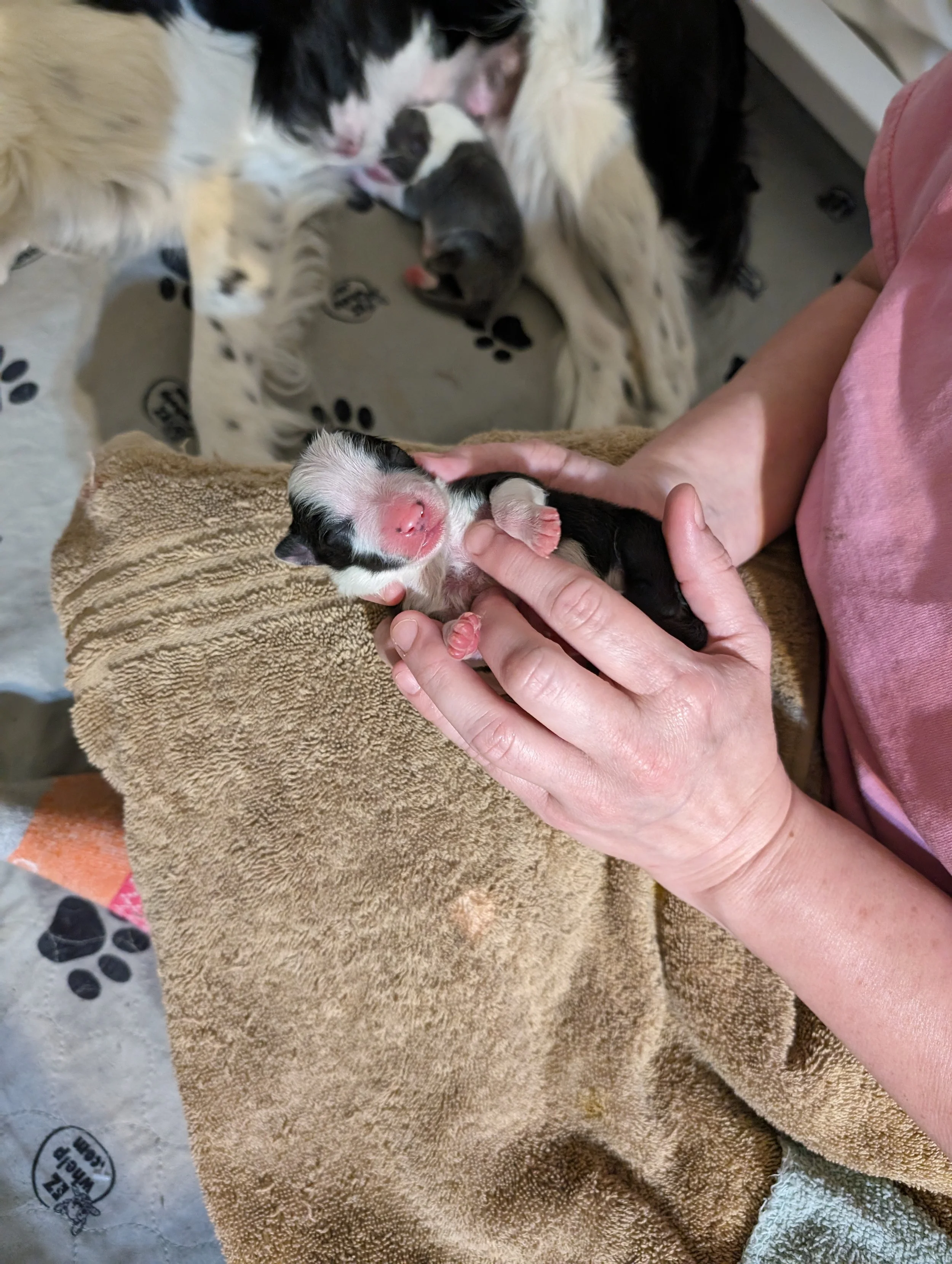
At Double 4 Farms, Early Neurological Stimulation (ENS) is a hands-on, carefully performed routine completed individually with every puppy during the critical developmental window (typically days 3–16 of life). These exercises take only seconds per puppy, but they are done with precision, consistency, and close observation to ensure each pup benefits without stress.
ENS is always performed in a calm, controlled environment, with clean hands, gentle handling, and careful attention to each puppy’s comfort level and responses.
——————————————————————————————————————————————————————————————————————————————
Our Step-by-Step ENS Routine
Each puppy is handled individually once per day, and we perform a series of five brief neurological exercises. Each exercise lasts only a few seconds and is done gently and deliberately.
1. Tactile Stimulation (Touch Between the Toes)
We gently stimulate the area between the puppy’s toes using a clean fingertip or soft tool.
Purpose:
This mild neurological input encourages early nerve pathway development and helps puppies become comfortable with handling and touch. This early exposure supports future tolerance of grooming, nail trims, and routine physical handling.
2. Head Held Upright
The puppy is gently held in an upright position with its head naturally elevated.
Purpose:
This introduces mild vestibular stimulation (balance and spatial orientation). It helps the nervous system adapt to positional changes that will be common later in life, such as being picked up, carried, or placed on new surfaces.
3. Head Pointed Downward
Next, the puppy is gently held with its head angled slightly downward for a few seconds.
Purpose:
This safe positional shift encourages the developing nervous system to process new orientation changes calmly. It promotes adaptability and reduces sensitivity to movement or unexpected positioning later in life.
4. Supine Position (On the Back)
We gently place the puppy on its back in our hands, fully supported, for a few seconds.
Purpose:
This introduces a very mild and controlled challenge that helps build early stress tolerance. Puppies learn that brief vulnerable positions are safe, which contributes to confidence during vet exams, grooming, and routine handling throughout life.
5. Thermal Stimulation (Cool Surface Exposure)
Finally, the puppy is briefly placed on a clean, cool (not cold) surface such as a sanitized tile.
Purpose:
This mild temperature change encourages early adaptability and resilience. It gently challenges the puppy’s ability to respond to new sensations without fear, supporting improved stress recovery later in life.
——————————————————————————————————————————————————————————————————————————————
Why Position Changes Matter: Supporting Healthy Neurological Development
During the ENS routine, puppies are gently positioned upright, head-down, and on their backs for just a few seconds each. These brief positional changes are intentional and developmentally important.
When a puppy is safely turned in different orientations, it creates mild, temporary shifts in circulation and sensory input that stimulate the developing neurological system. These gentle changes help the body adapt to new positions, supporting healthy neurological responses, coordination, and strong brain-body communication.
The goal is not to “force” circulation changes, but to provide safe, short-duration positional experiences that encourage the puppy’s system to regulate itself efficiently. Over time, this contributes to improved balance, adaptability, and confidence when puppies later encounter real-life movements such as being picked up, rolled over for grooming, or navigating uneven terrain.
Because these exercises are extremely brief and carefully controlled, they provide beneficial stimulation without causing stress. Each puppy is always securely supported to ensure comfort and safety while still receiving the full neurological benefit of these controlled orientation changes.
How We Ensure ENS Is Done Correctly
At Double 4 Farms, ENS is never rushed or mechanical. We:
Work with one puppy at a time
Closely observe body language and comfort levels
Keep each exercise brief and positive
Stop immediately if a puppy shows distress
Maintain strict cleanliness and consistency
Our goal is not to overwhelm a puppy, but to introduce tiny, manageable neurological challenges that the developing brain can process safely and confidently.
The Difference ENS Makes
Because we perform this routine carefully with every puppy, we often see Border Collies who grow into dogs that are:
More adaptable to change
Quicker to recover from new situations
Comfortable being handled and examined
Emotionally balanced and confident in new environments
For an intelligent and sensitive breed like the Border Collie, this early neurological foundation can make a lifelong difference in resilience, confidence, and trainability.
Early Scent Introduction (ESI)
Early Scent Introduction (ESI) is conducted during the same early developmental window as ENS. Each day, every puppy is gently exposed to a new scent, allowing the developing brain to begin forming scent-recognition pathways.
These scents are safe, mild, and varied — giving puppies early opportunities to engage their natural curiosity and problem-solving abilities.
Why ESI Matters
Border Collies are naturally observant, intelligent, and perceptive. Early scent exposure helps:
Enhance scent recognition and tracking ability
Build curiosity and engagement with the environment
Improve confidence when encountering unfamiliar surroundings
Strengthen early cognitive development
This early scent work lays the foundation for success in obedience, farm work, scent sports, service work, and everyday life as a confident companion.
Purposeful Socialization: Building Confident, Well-Rounded Puppies
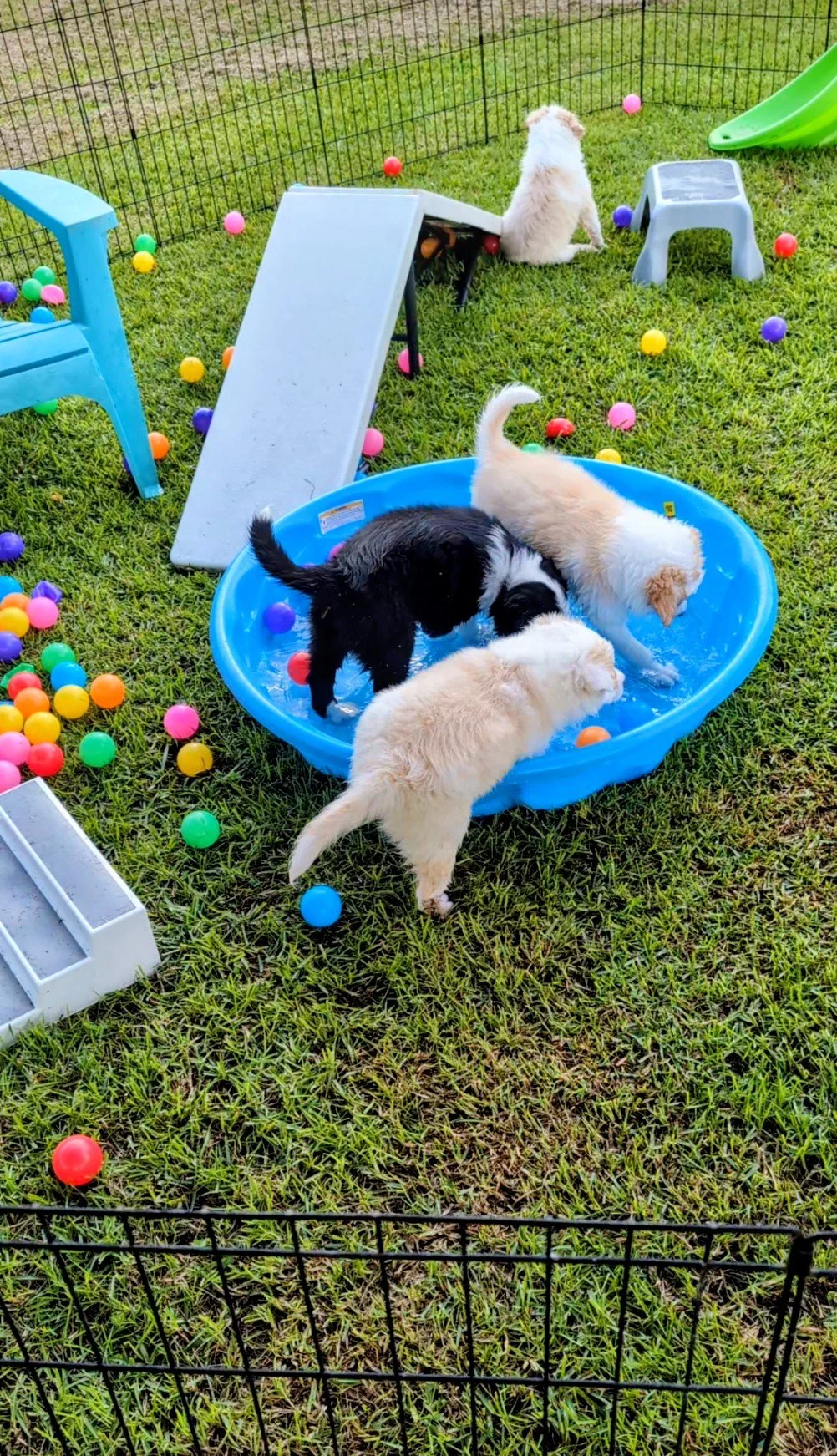
Socialization is far more than simply “meeting people.” At Double 4 Farms, it is a structured, intentional process that introduces puppies to the sights, sounds, textures, and experiences they will encounter throughout life.
Our goal is to raise puppies who are:
Confident but not pushy
Curious without being anxious
Emotionally balanced and adaptable
Engaged learners who enjoy new experiences
Through guided, positive exposures, puppies learn that the world is safe, interesting, and rewarding to explore.
Unique Real-World Socialization Opportunities at Double 4 Farms
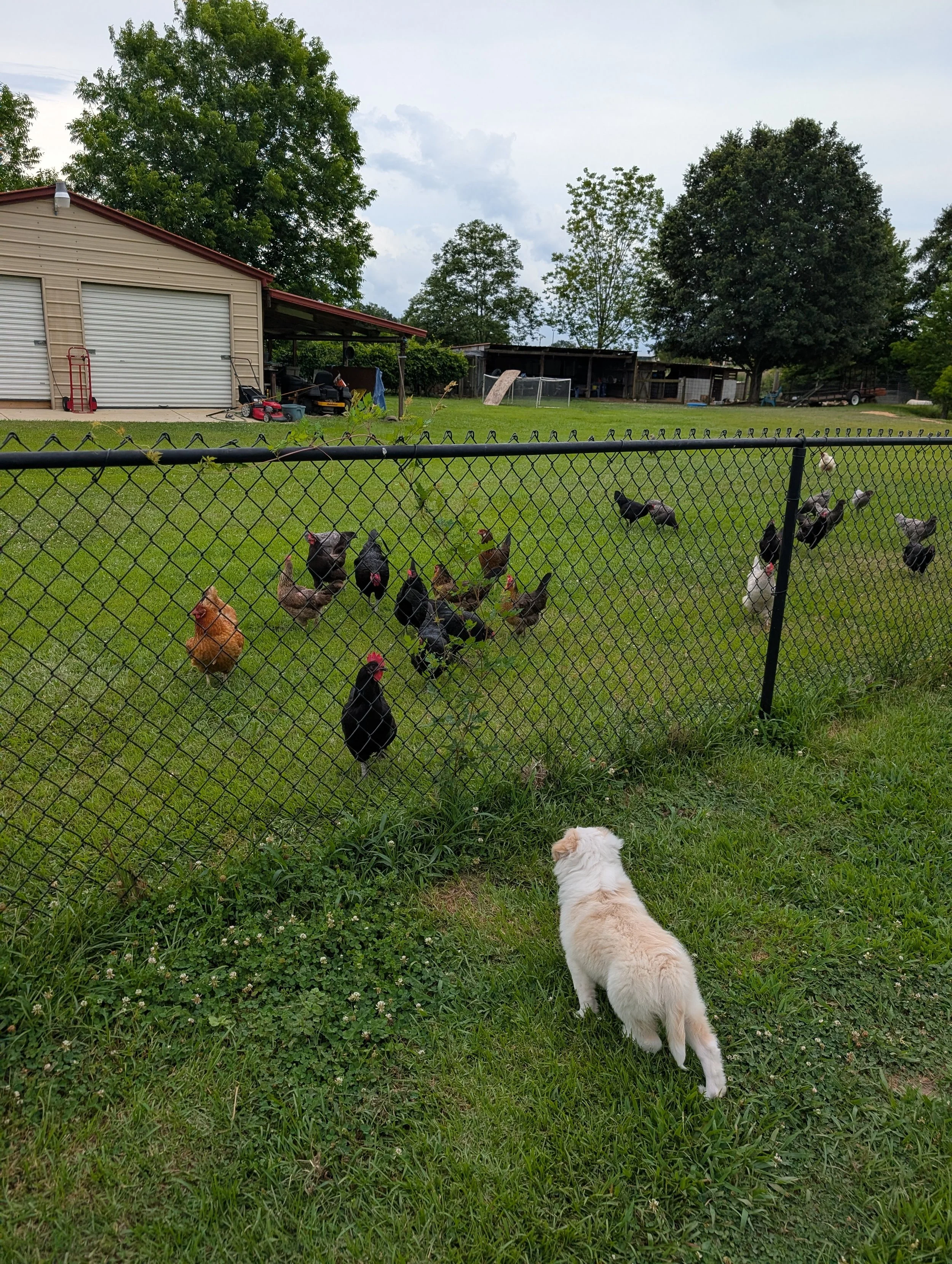
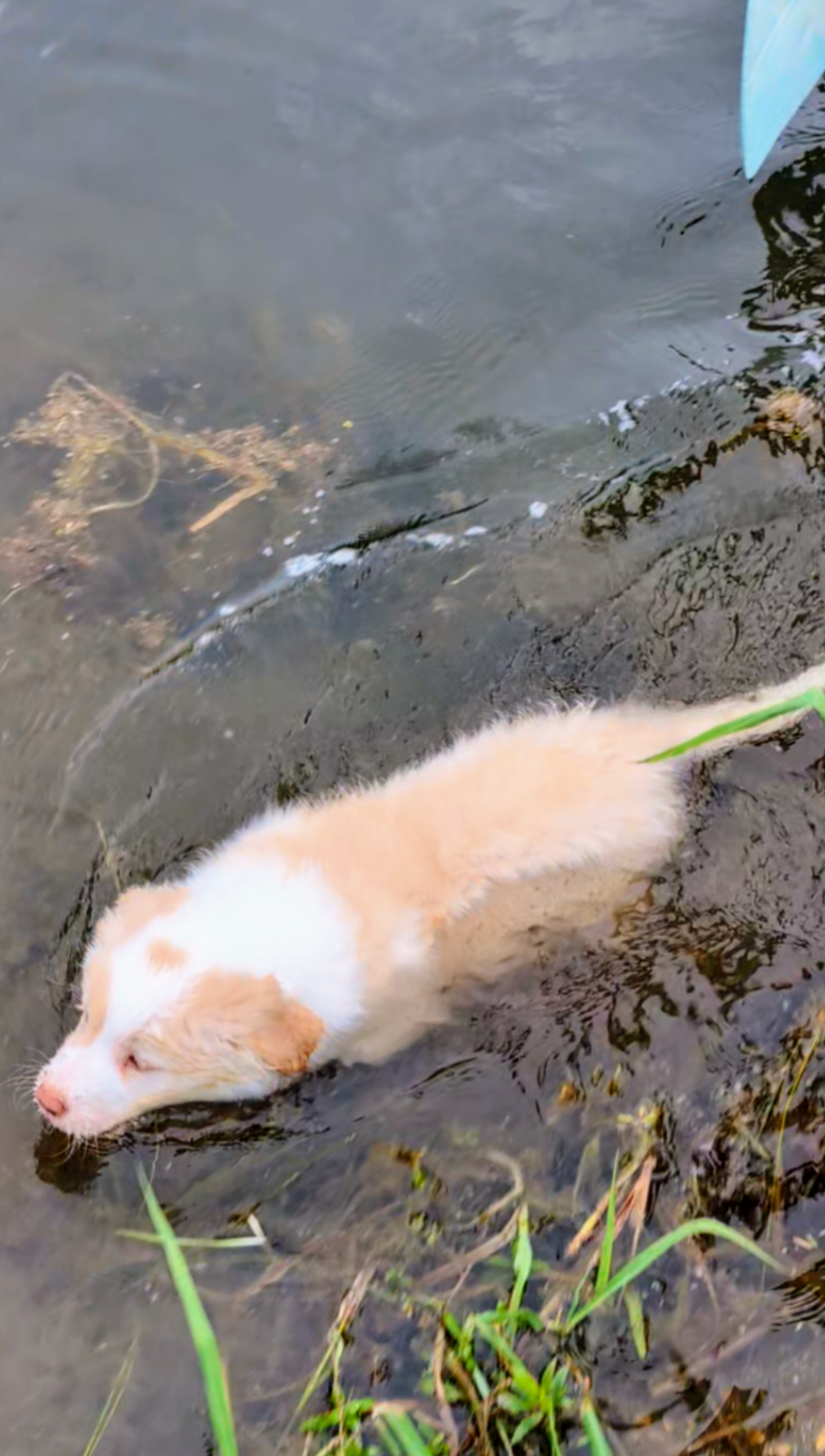
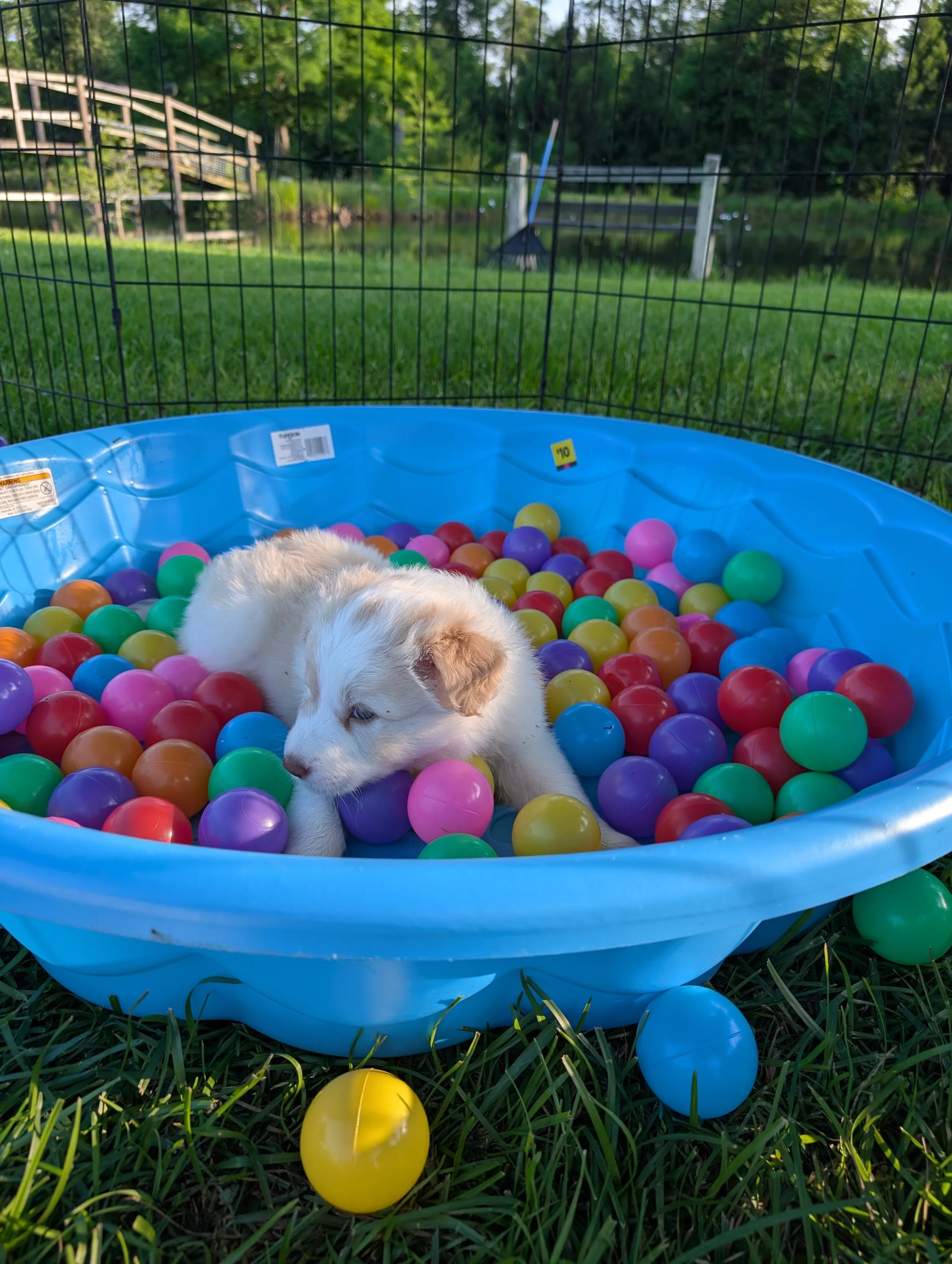
Because our puppies are raised on our active South Alabama homestead, they are exposed to a wide variety of carefully supervised, real-life experiences that many breeders simply cannot offer in more limited environments. These exposures are always introduced gradually, positively, and at developmentally appropriate stages.
Our puppies may experience safe, structured exposure to:
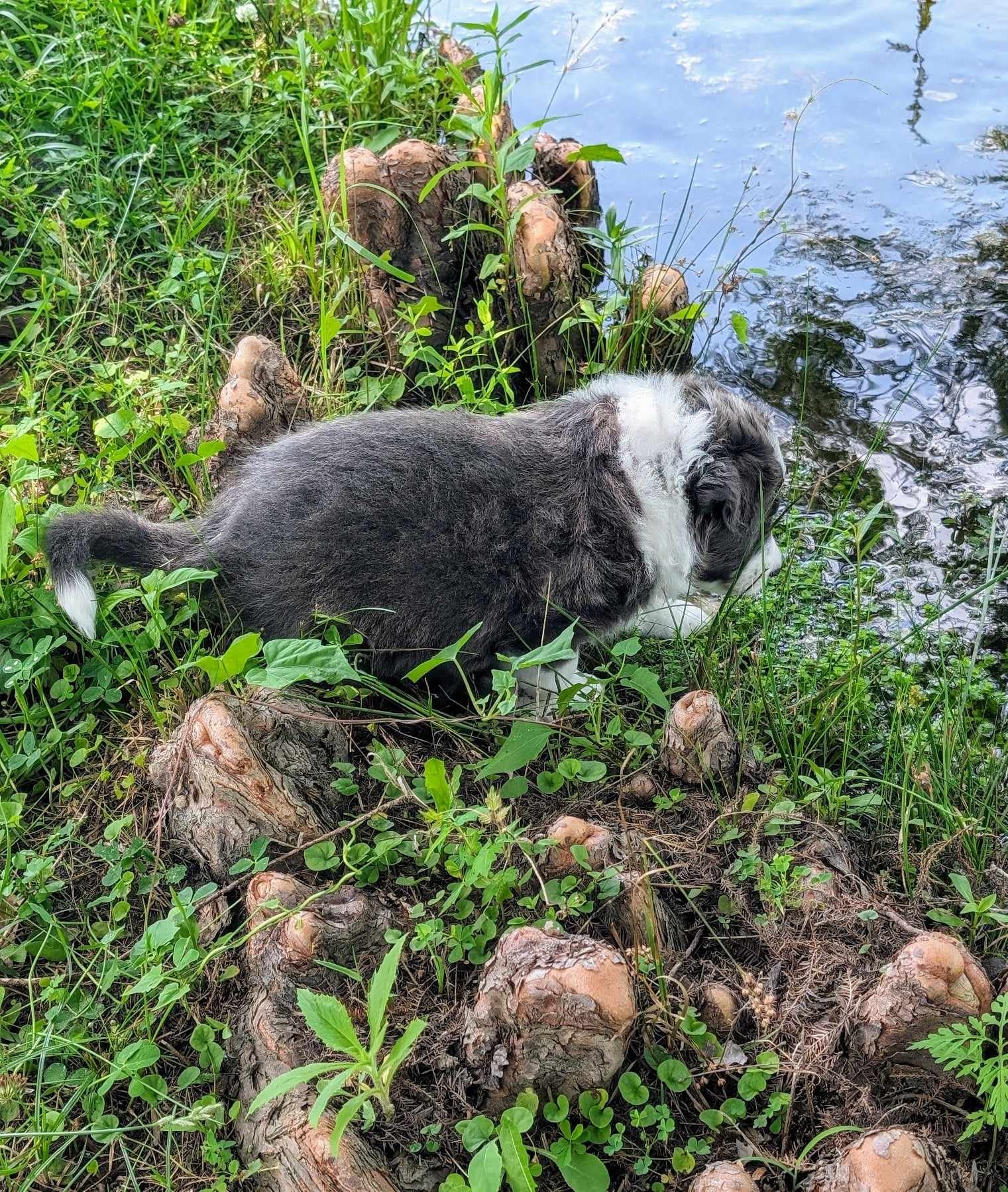
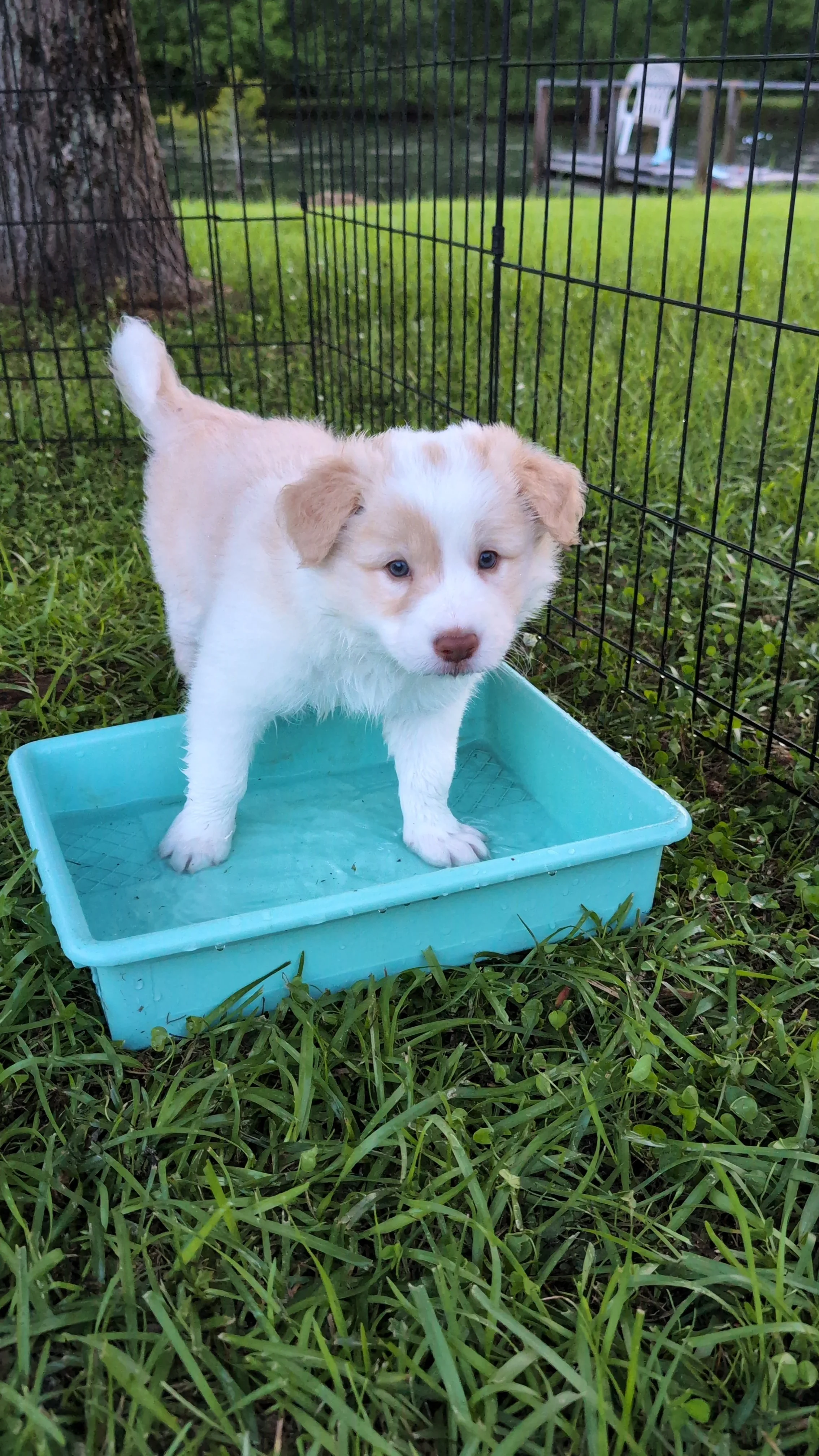
Pond environment and natural water sights and sounds
Chickens and poultry movement and noises
Goats and general livestock activity
Small bridges and elevated surfaces
Open fields and varied terrain
Barn cats and small animal movement
Riding lawn mowers and common farm equipment sounds
Everyday farm noises including tools, gates, and distant machinery
Children of different ages in calm, supervised interactions
Adults of varying ages and appearances
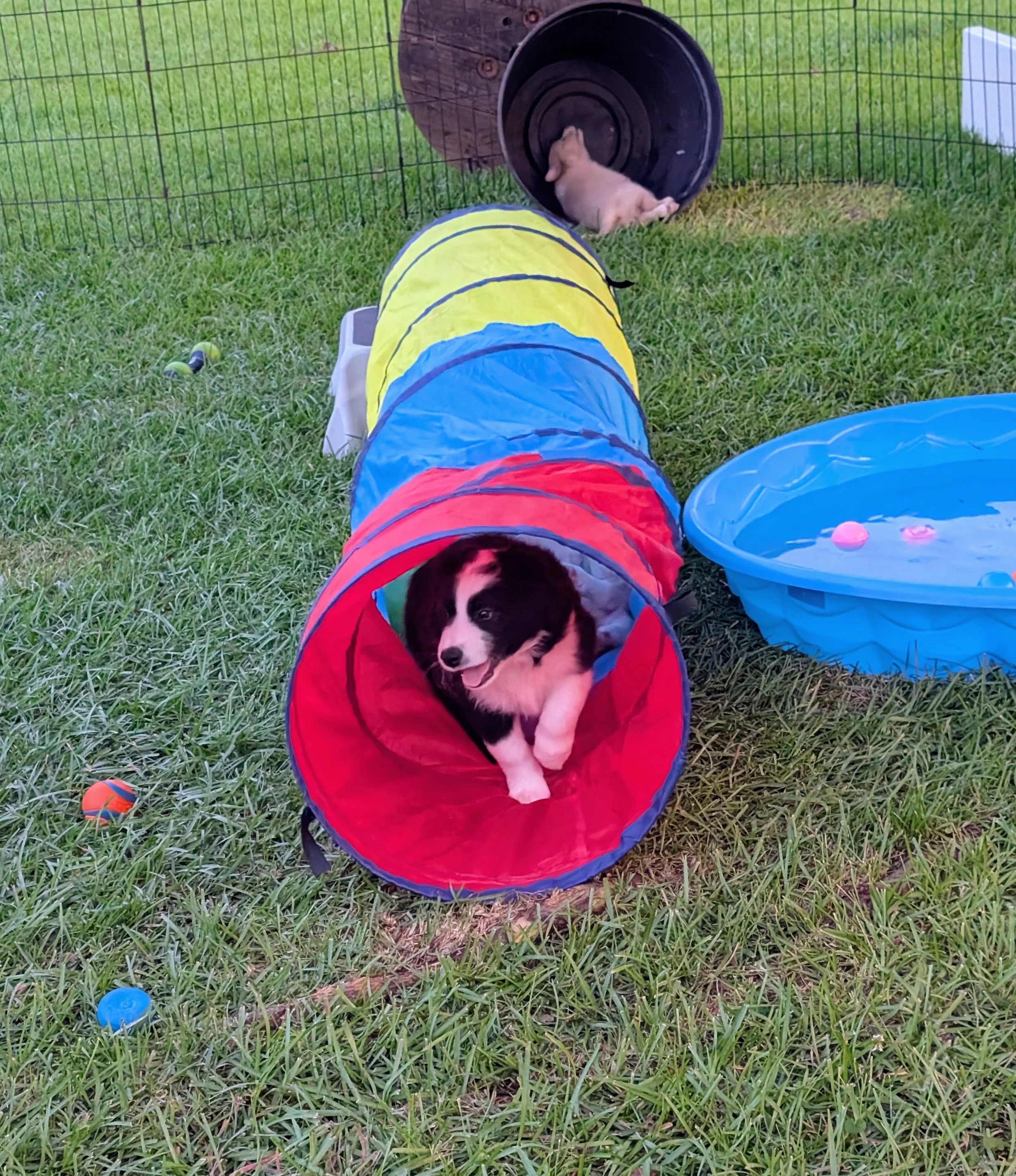
Different ground textures such as grass, dirt, gravel, decking, and mats
Normal household noises like vacuums, televisions, and doors
Positive crate and puppy pen exposure
Gentle introduction to collars and early leash awareness
Short, positive vehicle ride experiences
Supervised exposure to mild weather elements such as wind and light rain sounds
Routine handling exercises including ears, paws, tail, and mouth
Regular visitors and new friendly faces outside the immediate family
Gradual expansion into new safe exploration areas beyond the whelping space
Mild, controlled novel sounds to encourage healthy startle recovery and resilience
Why This Level of Socialization Matters
Border Collies are exceptionally intelligent and environmentally aware. Without proper early exposure, they can become overly sensitive to movement, noise, or unfamiliar environments. By thoughtfully introducing puppies to real-world sights, sounds, surfaces, animals, and people, we help them develop into stable, confident, and adaptable dogs.
Because our puppies grow up immersed in authentic farm and family life, they are not sheltered from the world — they are carefully prepared for it.
This diverse environment helps foster:
Strong environmental confidence
Sound tolerance and adaptability
Healthy curiosity without fearfulness
Emotional stability in busy or unpredictable settings
In short, our puppies don’t just learn to cope with the world — they learn to embrace it.
The Lasting Difference for Our Puppies and Their Families
The combination of ENS, ESI, and extensive real-world socialization creates a powerful developmental advantage. Families often tell us that Double 4 Farms puppies are:
Confident when transitioning to new homes
Highly trainable and eager to engage
Calm yet enthusiastic learners
Adaptable to family life, farms, sports, or working roles
These early foundations help set each puppy up for lifelong success — whether they are destined to be a beloved companion, a working farm partner, or a competitive performance dog.
Our Commitment at Double 4 Farms
We believe great dogs are not only the result of strong genetics, but of intentional early development. By investing time, care, and proven developmental practices into ENS, ESI, and immersive socialization, we give every puppy the strongest possible start in life.
This is more than a program.
It is our promise to raise Border Collies who are confident, capable, and ready to thrive wherever life takes them.
The History & Research Behind ENS & ESI
Understanding why we use Early Neurological Stimulation (ENS) and Early Scent Introduction (ESI) begins with looking at where these methods originated and what research and working-dog programs have shown over time.
Both practices are rooted in decades of canine developmental research and practical application in military and working-dog breeding programs designed to produce more resilient, adaptable, and trainable dogs.
The Origins of Early Neurological Stimulation (ENS)
Early Neurological Stimulation traces back to a U.S. military canine development program originally called the “Bio Sensor” program, later widely known as the “Super Dog Program.” The program was developed to enhance the performance and resilience of military working dogs through controlled early-life neurological challenges.
The military identified a critical developmental window in puppies — roughly days 3 through 16 of life — when the nervous system is rapidly growing and highly responsive to mild stimulation. During this period, very brief, controlled exercises were introduced to gently activate the neurological system earlier than would naturally occur.
The original Bio Sensor program used a short series of five exercises performed once daily for just a few seconds each, designed to stimulate neurological, vestibular, and physiological responses during this sensitive growth stage.
What Early Military and Working-Dog Programs Observed
Early reports from military and working-dog programs suggested that puppies exposed to controlled early stimulation demonstrated several long-term advantages, including:
Improved cardiovascular performance
Stronger adrenal gland response
Greater tolerance to stress
Increased disease resistance
Improved overall performance and adaptability
These observations helped popularize ENS among breeders raising detection, guide, service, and performance dogs.
What Scientific Research Says About Early Stimulation
Modern developmental research confirms that early life is a critical period of neurological growth, during which young mammals are highly responsive to mild stimulation and environmental enrichment.
Studies across animal development show that appropriate early-life challenges can influence how individuals respond to stress, novel environments, and problem-solving tasks later in life. Research also indicates that results depend on proper application, emphasizing that moderation, gentle handling, and overall enrichment are key to positive outcomes.
ENS is therefore not a shortcut — but when combined with excellent genetics, proper socialization, and a rich developmental environment, it can meaningfully contribute to resilience and adaptability.
The Developmental Science Behind ENS
During the first two weeks of life, puppies are neurologically immature but rapidly developing. Carefully introducing brief, controlled sensory and positional changes encourages the nervous system to process and adapt to new stimuli in a safe, manageable way.
This early stimulation supports:
Improved neurological responsiveness
Better stress recovery later in life
Greater adaptability to change
Stronger brain-body coordination
The Background of Early Scent Introduction (ESI)
While ENS originated from military neurological conditioning programs, Early Scent Introduction (ESI) developed through working-dog, detection-dog, and performance-dog breeding programs.
Handlers observed that scent detection is one of the earliest developing senses in neonatal mammals. Introducing safe, varied scents during early developmental stages encourages puppies to form scent-recognition pathways and curiosity toward environmental odors.
Although formal peer-reviewed research specific to ESI in puppies is still emerging, broader developmental science confirms that olfactory stimulation plays a significant role in early behavioral development across mammals.
ENS, ESI, and Modern Breeding Programs
Today, ENS and ESI are widely used in responsible breeding programs focused on raising:
Service and therapy dogs
Detection and working dogs
Performance and sport dogs
Stable, confident family companions
Reputable breeders combine these early developmental techniques with proper socialization, enrichment, and positive real-world exposure, recognizing that no single method replaces the importance of genetics, environment, and continued training.
A Balanced, Evidence-Based Perspective
While many programs and breeders report positive long-term outcomes, research suggests ENS works best as one part of a comprehensive early development program, not as a standalone solution.
The greatest benefits are seen when ENS is paired with:
Rich socialization experiences
Environmental enrichment
Positive human interaction
Stable, well-bred genetic lines
Why We Use ENS & ESI at Double 4 Farms
At Double 4 Farms, we don’t rely on trends or buzzwords. We use ENS and ESI because their foundations come from working-dog programs, breeder experience, and developmental science showing that early life experiences matter.
By combining:
Proven early neurological stimulation
Early scent engagement
Extensive real-world socialization on our working homestead
…we help our Border Collie puppies develop the confidence, resilience, and adaptability needed to thrive in a wide variety of homes and roles.
These methods are not shortcuts. They are carefully applied developmental tools — used thoughtfully, gently, and always in the best interest of each individual puppy.
—————————————————————————————————————————————————————————————————————————————-
Research and information regarding ENS-ESI-& socialization
Primary Historical & Foundational Sources for ENS
1. U.S. Military “Bio Sensor” / “Super Dog” Program
The ENS protocol originates from early U.S. military canine development programs designed to enhance the performance and resilience of military working dogs.
Core reference often cited:
Battaglia, C. L. (2009). Early Neurological Stimulation. AKC Gazette / AKC Breeder resources.
Often referred to as the “Bio Sensor” or “Super Dog” program description.
These describe:
The 3–16 day neurological window
The five ENS exercises
Observed long-term performance advantages in working dogs
2. Carmen L. Battaglia, PhD – Foundational ENS Research & Writing
Dr. Battaglia is the most widely cited authority translating the Bio Sensor program into breeder application.
Key publications:
Battaglia, C. L. (2009). Early Neurological Stimulation (ENS). American Kennel Club (AKC).
Battaglia, C. L. (2016). Breeding Better Dogs. AKC Canine Health Foundation / AKC Gazette articles.
These writings summarize:
Early neurological stimulation concepts
Effects on stress tolerance, adrenal response, and adaptability
Proper timing and limitations of ENS
AKC resource overview page:
American Kennel Club. “Breeder Puppy Socialization & Early Neurological Stimulation.”
Scientific & Developmental Research Supporting Early Stimulation
While ENS itself is derived from applied working-dog programs, its biological basis is supported by broader research in early mammalian neurological development and stress-response conditioning.
3. Early Handling & Developmental Stress Research (General Mammalian Studies)
These studies demonstrate that mild early-life stimulation can influence long-term stress resilience and neurological responsiveness.
Key research themes appear in:
Levine, S. (1967–2005). Early handling and stress response development in mammals.
Meaney, M. J. (2001). Maternal care and stress reactivity in offspring.
These foundational studies established that early mild stimulation affects HPA-axis development (stress regulation system).
These are not dog-specific, but they form the biological rationale behind ENS timing and mild stress exposure concepts.
4. Puppy Development & Critical Period Research
Widely accepted behavioral science references include:
Scott, J. P., & Fuller, J. L. (1965). Genetics and the Social Behavior of the Dog.
Established critical developmental periods in puppies
Demonstrated early environmental effects on adult behavior
Fox, M. W. (1978). The Dog: Its Domestication and Behavior.
Discussed neurological maturation stages and environmental influence
These works underpin the concept that early developmental windows significantly shape future temperament and adaptability.
Working-Dog & Service Dog Program Adoption
ENS has been widely adopted in programs raising:
Military working dogs
Detection dogs
Service and guide dogs
While many program protocols are proprietary, references appear in:
Guide Dogs for the Blind breeder development practices (general breeder education materials)
Various detection-dog breeding program training manuals referencing early neurological stimulation routines
These confirm ENS is not a fad but a long-standing working-dog development technique.
Sources & Scientific Basis Behind ESI (Early Scent Introduction)
There is currently less direct peer-reviewed research specifically on ESI in puppies compared to ENS.
However, ESI is grounded in broader, well-established developmental neuroscience and olfactory research.
5. Olfactory Development Research (Mammalian Neonatal Studies)
These studies support early scent exposure as beneficial for sensory pathway development:
Sullivan, R. M. (2001). The neurobiology of olfactory learning in neonatal mammals.
Leon, M. (1992). Olfactory learning in neonatal animals.
These show:
Olfaction is one of the earliest functioning senses in mammals
Early scent exposure influences recognition learning and exploratory behavior
This provides the scientific rationale for structured early scent introduction in puppies.
Modern Breeder & Puppy-Raising Program Influences
6. Puppy Culture Program (Jane Killion)
While not a peer-reviewed scientific publication, Puppy Culture is widely respected in ethical breeding circles and draws from developmental and behavioral science.
Reference:
Killion, J. (2013). Puppy Culture: The Powerful First Twelve Weeks That Can Shape Your Puppy’s Future.
This program integrates:
ENS-style early stimulation concepts
Structured socialization phases
Developmental milestone-based exposure planning
Sources used:
Our ENS and ESI protocols are based on the U.S. military “Bio Sensor” early neurological stimulation program, AKC breeder development resources, Puppy Culture socialization principles, and established research on early neurological and olfactory development in mammals.
Sources used for ENS / ESI background and claims (numbered + linked)
1) AKC: “Puppy Socialization Starts with the Breeder” (includes ENS timing 3–16 days)
https://www.akc.org/expert-advice/dog-breeding/breeder-puppy-socialization-early-neurological-stimulation/
Supports: general breeder socialization + mentions ENS during days 3–16.
2) AKC: “Early Puppy Development” (mentions ENS + ESI together; timing guidance)
https://www.akc.org/expert-advice/dog-breeding/early-puppy-development/
Supports: ENS and ESI both discussed as early-development practices; timing window.
3) Boone et al. 2022 (peer-reviewed): “The Effect of Early Neurological Stimulation on Puppy Welfare…”
https://pmc.ncbi.nlm.nih.gov/articles/PMC9818019/
Supports: a controlled study evaluating “ENS/early handling” effects in puppies; also highlights mixed/inconclusive outcomes in dogs
4) PubMed record for Boone et al. 2022 (same study; quick citation view)
https://pubmed.ncbi.nlm.nih.gov/36611681/
Supports: easy-to-cite abstract/metadata for the same paper.
5) BreedingBetterDogs (Battaglia’s ENS write-up / “Super Dog” / Bio Sensor popularization)
https://breedingbetterdogs.com/article/early-neurological-stimulation
Supports: breeder-facing history and description commonly associated with ENS/Bio Sensor/Super Dog discussions.
6) Purdue Extension PDF (breeder education handout; cites Battaglia + J. Vet. Behav. paper)
https://www.extension.purdue.edu/extmedia/VA/VA-24-W.pdf
Supports: a structured educational handout; includes citations to Battaglia (2009) and other early experience literature.
7) Scott & Fuller (classic canine development work; critical periods / early experience)
University of Chicago Press page:
https://press.uchicago.edu/ucp/books/book/chicago/G/bo42153960.html
Supports: foundational canine behavior development work often referenced in socialization/critical period discussions.
8) Fox & Stelzner (1966): “Behavioural effects of differential early experience in the dog”
ScienceDirect: https://www.sciencedirect.com/science/article/pii/S0003347266800830
PubMed: https://pubmed.ncbi.nlm.nih.gov/5956591/
Supports: early handling/early experience effects in dogs (dog-specific early experience literature).
9) Puppy Culture (program framework many breeders reference for socialization/enrichment)
About Puppy Culture:
https://shoppuppyculture.com/pages/about-puppy-culture
Supports: what the program is and how it frames early development/socialization.
10) Neonatal olfactory learning (mammal research that supports the concept behind early scent exposure)
“Unique Neural Circuitry for Neonatal Olfactory Learning” (review):
https://pmc.ncbi.nlm.nih.gov/articles/PMC1868533/
Supports: early-life olfactory learning and brain plasticity in neonates (not puppy-specific, but supports the developmental rationale behind ESI).
11) Additional neonatal olfactory learning evidence (mammal research; strengthens the ESI rationale)
“Olfactory learning in the rat neonate soon after birth” (review):
https://pmc.ncbi.nlm.nih.gov/articles/PMC2574692/
Supports: early olfactory learning is widespread in mammals; neonates learn odor associations very early.
12) NCBI Book chapter: “Memory and Plasticity in the Olfactory System”
https://www.ncbi.nlm.nih.gov/books/NBK55967/
Supports: broader overview of olfactory learning/memory mechanisms (again, not puppy-specific; used to justify “olfaction develops early” without overclaiming).
——————————————————————————————————————————————————————————————————————————————
A Note on Research and Responsible Interpretation
At Double 4 Farms, we strive to present information about Early Neurological Stimulation (ENS) and Early Scent Introduction (ESI) accurately and responsibly. These practices are supported by a combination of breeder education resources, working-dog development programs, and broader research in early neurological and sensory development.
It is important to understand that ENS is associated with potential benefits such as improved resilience, adaptability, and stress recovery when applied correctly during the early developmental window. However, outcomes can vary depending on genetics, environment, and overall puppy-raising practices. For this reason, ENS should be viewed as one supportive component of a comprehensive early development program, rather than a guaranteed predictor of specific behavioral or performance outcomes.
Similarly, Early Scent Introduction (ESI) is grounded in well-established knowledge that olfaction is one of the earliest developing senses in neonatal mammals. While the developmental rationale for early scent exposure is strong, large-scale controlled studies specifically focused on ESI in puppies remain more limited. Therefore, ESI is best understood as a structured early exposure practice informed by olfactory development science, rather than a standalone method that ensures specific future abilities.
By combining ENS, ESI, strong genetics, and extensive real-world socialization, our goal is not to promise perfection, but to thoughtfully support each puppy’s confidence, adaptability, and overall developmental foundation.